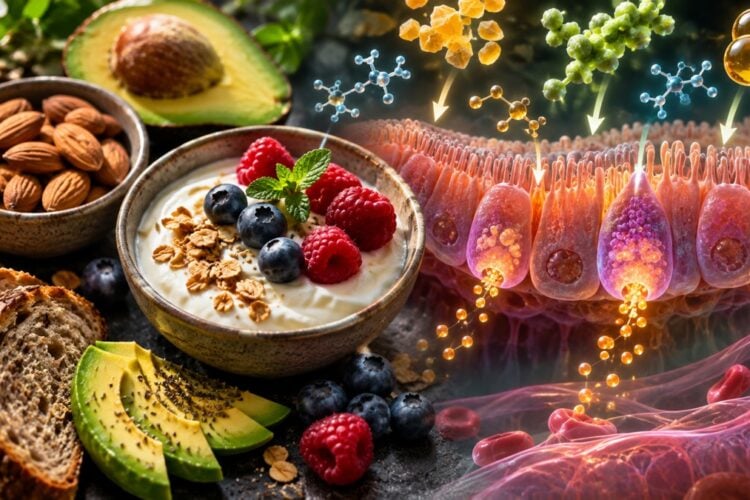
A slice of bread, a handful of almonds and a spoonful of yogurt may seem like ordinary foods, but each presents the digestive system with a remarkably different collection of chemical information. As digestion progresses, specialized cells within the intestinal lining recognize components of these foods and translate their presence into biological signals.
The process involves far more than breaking food into smaller molecules. The digestive system must coordinate nutrient absorption, communicate with other organs and adjust its activity as the chemical composition of its contents changes.
Among the cells responsible for these tasks are enteroendocrine cells, a specialized population scattered throughout the gastrointestinal lining. Their ability to recognize nutrients and release chemical messengers has become an important subject in food science, endocrinology and peptide research.
Understanding these cells offers a different perspective on what happens after a meal and helps explain why researchers distinguish naturally occurring biological signals from experimental compounds and pharmaceutical interventions.
The Intestine Has Its Own Chemical Sensory System
People experience food through familiar senses such as taste, smell and texture. However, the recognition of food continues long after these conscious sensations have disappeared.
Within the digestive tract, nutrients encounter specialized proteins that recognize particular chemical characteristics. These proteins participate in biological processes that allow cells to detect changes in their surrounding environment.
Enteroendocrine cells are particularly interesting because they connect chemical recognition with hormonal communication. Some of these cells have surfaces exposed to the intestinal contents, allowing them to encounter molecules released during digestion.
When appropriate biological signals are detected, intracellular processes can lead to the release of hormones. These messengers contribute to the coordination of digestive activity and metabolic responses.
A 2019 review by Fiona Gribble and Frank Reimann in Nature Reviews Endocrinology describes how enteroendocrine cells integrate information about nutrients, microbial products and the intestinal environment.
Their research illustrates why the digestive tract cannot be understood simply as a system of tubes that transport and absorb food. It also contains a distributed network of biological sensors.
Readers seeking introductory information about peptide-related scientific terminology can consult this peptide research resource alongside original scientific publications and established educational materials.
What Happens When the Intestine Encounters Carbohydrates?
Carbohydrates differ considerably in their chemical structure. Some contain relatively simple sugar molecules, while others consist of longer molecular chains that must undergo digestion before their components become available for absorption.
As these processes occur, intestinal cells encounter substances that can participate in nutrient recognition.
One protein that has received considerable scientific attention is the sodium-glucose cotransporter known as SGLT1. It participates in moving glucose across cell membranes together with sodium ions.
In certain enteroendocrine cells, this transport process can alter the electrical properties of the cell membrane. The resulting changes may contribute to intracellular events associated with hormone secretion.
This mechanism demonstrates an important principle of nutrient sensing: a transporter can participate in both the movement of molecules and the generation of biological information.
A 2015 review published in the Journal of Clinical Investigation examined this relationship between nutrient transport, cellular electrical activity and gastrointestinal hormone release.
These observations do not establish that every carbohydrate-containing meal produces an identical hormonal response. Food composition, digestive conditions and individual biological characteristics can influence the measurements obtained in research settings.
Protein Digestion Creates Its Own Collection of Signals
Proteins introduce another layer of complexity to intestinal nutrient recognition. Their structures consist of amino acids connected through peptide bonds, and digestion progressively separates these structures into smaller components.
The resulting mixture may contain individual amino acids and short peptide fragments. Researchers investigate how these substances interact with intestinal transport proteins and cellular receptors.
The calcium-sensing receptor, for example, has been studied for its involvement in recognizing certain amino acid-related signals. Other proteins participate in transporting small peptides and amino acids across cellular membranes.
These interactions contribute to the scientific understanding of how intestinal cells respond to digested proteins.
However, the presence of a peptide fragment in a food digestion study does not mean that the fragment possesses the same properties as a naturally occurring peptide hormone or a laboratory-designed research compound.
Molecular identity, biological recognition and evidence of physiological activity must be evaluated separately.
This distinction is especially relevant when scientific findings about dietary proteins are discussed alongside research involving synthetic peptides. Sharing a chemical classification does not establish equivalent biological behavior.
How Dietary Fats Contribute to Hormonal Communication
Dietary fats present a different recognition challenge because their chemical structures and interactions with water differ from those of carbohydrates and proteins.
During digestion, fats are processed into components that include fatty acids and other lipid-related molecules. The intestinal environment contains specialized proteins capable of responding to some of these substances.
Researchers have identified several free fatty acid receptors involved in intestinal nutrient sensing. Different receptors can exhibit different patterns of recognition depending on the chemical characteristics of the fatty acids being investigated.
Some of these interactions influence intracellular signaling pathways associated with the release of gastrointestinal hormones.
The presence of multiple recognition mechanisms helps explain why scientists investigate dietary fats as diverse molecular substances rather than treating them as one uniform chemical category.
Research into these pathways also requires careful interpretation. An observation involving a particular fatty acid and a specific cellular receptor does not establish that an entire food produces the same biological effect under ordinary conditions.
Whole foods contain complex combinations of nutrients, water, structural components and other substances. Their biological effects cannot always be predicted from isolated molecular observations.
Why the Physical Structure of Food Matters
Two foods can contain similar amounts of protein, carbohydrates and fat while differing substantially in their physical structure.
A whole almond, for example, presents its nutrients within a cellular structure that differs from a finely ground almond preparation. The physical arrangement of food components can influence how those components become available during digestion.
Food scientists refer to the arrangement and interactions of nutrients within a food as its food matrix.
This concept is valuable when investigating digestive signaling because intestinal cells respond to the chemical environment they encounter, rather than simply to the nutritional information printed on a package.
The order in which nutrients become available, their distribution throughout the digestive tract and their interactions with other food components can complicate experimental interpretation.
Consequently, a laboratory investigation involving an isolated nutrient may provide useful mechanistic information without fully reproducing the biological conditions created by a complete meal.
Understanding the difference between these research approaches helps readers interpret food-science findings without assuming that every isolated observation translates directly into an everyday dietary outcome.
One Meal Can Generate Multiple Peptide Hormone Signals
Enteroendocrine cells participate in the production of several hormones with different biological functions. Among the most frequently investigated are glucagon-like peptide-1, glucose-dependent insulinotropic polypeptide, cholecystokinin and peptide YY.
These messengers contribute to processes associated with digestion, gastrointestinal movement, pancreatic activity and metabolic regulation.
Scientists investigate them individually to understand their molecular characteristics, but the digestive system does not operate through isolated signals alone.
Several hormonal responses may occur during overlapping periods after food consumption. Their relationships depend on the nutrients present, the distribution of responsive cells and the biological conditions of the individual.
This complexity is one reason that research into metabolic signaling requires distinctions between individual molecular mechanisms and broader physiological outcomes.
Measuring a change in one hormone does not establish everything that happens across the digestive system. It also does not demonstrate that an experimental substance produces a clinically meaningful health outcome.
Researchers must interpret hormonal measurements according to the methods, biological models and specific questions involved in each investigation.
The Gut Can Communicate Through Neural Pathways as Well
Hormonal communication represents an important component of digestive physiology, but research has identified additional mechanisms through which intestinal information can reach the nervous system.
In a 2018 study published in Science, Melanie Maya Kaelberer and colleagues investigated connections between specialized intestinal sensory cells and vagal neurons in mice.
The researchers identified a neural pathway through which intestinal sensory information could be communicated rapidly. Their observations supported the existence of direct connections between particular sensory cells and neurons involved in communication with the brainstem.
The study expanded scientific understanding of the ways intestinal signals may travel beyond the digestive tract.
Importantly, the investigation involved an animal model. Its findings cannot independently establish that every corresponding process occurs identically in humans or that manipulating these pathways produces a particular clinical benefit.
The research nevertheless provides a useful example of how investigations into digestive physiology can uncover communication mechanisms that extend beyond conventional descriptions of hormone release.
The Intestinal Microbiome Adds Another Dimension
The chemical environment of the digestive tract is influenced by more than recently consumed food. Microorganisms residing within the intestine participate in biological processes that generate additional molecules.
Among the substances investigated in this context are short-chain fatty acids, which can result from microbial fermentation of certain dietary components.
Research has identified receptors capable of responding to some microbial metabolites. Scientists continue to investigate how these interactions relate to intestinal signaling and gastrointestinal physiology.
A 2024 review in JGH Open examined the relationships between substances present within the intestinal environment, nutrient recognition and subsequent gastrointestinal responses.
This area of research demonstrates how the digestive system receives information from both dietary components and substances generated within its own biological environment.
However, microbiome research presents substantial interpretive challenges. Microbial communities vary among individuals, and their composition can change in response to numerous environmental and biological factors.
A finding associated with one microbial metabolite does not establish that a particular commercial food, supplement or research compound produces a predictable health outcome.
Why Naturally Occurring Hormones and Research Compounds Are Different
Scientific interest in gastrointestinal hormones has contributed to pharmaceutical research involving molecules that interact with related biological pathways.
One example is semaglutide, a molecule associated with GLP-1 receptor research and specific FDA-approved pharmaceutical products.
Readers examining information at peptideshartford.com/semaglutide/ should distinguish the evidence supporting approved pharmaceutical formulations from information concerning other materials described using the same molecular name.
The FDA has warned that unapproved versions of GLP-1 drugs do not undergo the same premarket evaluation of safety, effectiveness and quality as approved products.
Understanding the function of naturally occurring GLP-1 does not establish the suitability of an independently sourced research substance for human use.
Likewise, findings concerning nutrient-associated hormone secretion do not demonstrate that foods, supplements and pharmaceutical products are interchangeable simply because they are discussed in connection with the same signaling pathway.
Each requires evaluation according to its own scientific evidence, intended purpose and applicable regulatory framework.
What Food Science Can Teach Readers About Biological Evidence
The study of intestinal nutrient sensing illustrates the value of examining scientific claims at the appropriate biological level.
A molecular experiment may identify an interaction between a nutrient and a receptor. A cellular investigation may reveal a measurable change associated with that interaction. A human study may examine broader physiological responses under defined conditions.
These approaches contribute different forms of knowledge. Their findings can complement one another, but they cannot automatically substitute for one another.
For readers encountering discussions about food, hormones and peptide science, recognizing the differences between these evidence types is particularly useful.
It encourages attention to what researchers actually measured, the conditions under which their observations occurred and the limitations surrounding their conclusions.
The digestive system provides an extraordinary example of biological information processing. Every meal introduces a changing combination of chemical substances, physical structures and biological interactions. Specialized intestinal cells help translate portions of that information into signals that contribute to coordinated physiological activity.
Studying these mechanisms offers insight into the relationship between food and human biology without requiring exaggerated claims about individual nutrients or experimental compounds.
The most meaningful understanding comes from recognizing the complexity of the system and respecting the boundaries of the evidence used to explain it.